The Vicious Circle of Booking Platforms
It starts as a gift
Most booking platforms began as small startups, and at first they were genuinely attractive. They built a useful tool for everyone: hotel managers if we are talking about hotels, travel agencies and tour guides if we are talking about tours.
The cost was low. Sometimes it was almost free, sometimes there was even a free trial. This has a name: the lock-in strategy. Getting in is easy and cheap. Getting out, as we will see, is another story.
Then the investors arrive
As these companies grow, most of them look for investors, as startups do. An investor wants to double, triple, quadruple their money. That is the job: making money out of money.
So the platform changes. It was built to be useful to people. Now it has to be profitable for its shareholders, and those two goals do not always point in the same direction.
The trap closes
By this point, thousands of people are locked in. Guides have spent hours building their tours on the platform. Hotels have connected their rooms to its booking system. Sales start flowing through it.
Little by little, direct bookings dry up. One day, the guide or the hotel realises they can no longer sell anywhere else. That is exactly the moment the platform raises its commission, its fees or its publishing costs. Leaving is no longer an option, so the price goes up.
Everyone sells the same tours
As a tour guide, you publish your tours on one platform. Then you see another platform where your colleagues are selling, so you add your tours there too. Meanwhile, they add theirs to the platform you started on.
Imagine 100 guides offering 1,000 tours. Platform A lists those 1,000 tours. Platform B lists the same 1,000. Platform C, the same again. The catalogues are identical.
So who actually sells the tour? That is where the race begins.
The race for page one
When every platform sells the same product, the only thing left to compete on is visibility. Everyone fights for the first page of a few major search engines, and everyone pays for it.
One of the large tour platforms published its finances. Here is roughly where the money from one year went:
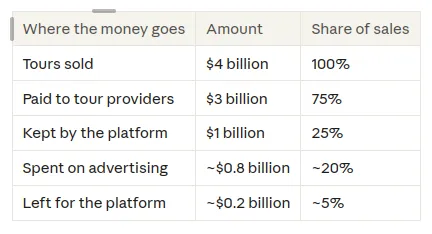
Read that again. Out of every $100 a traveller spends, around $20 goes to advertising, mostly to a couple of big companies. The platform fights for its last $5, and to earn it, it pays $20 to the search engines.
Every platform is selling the same tour. They are all racing for that 5%. And the travellers and the guides are the ones funding the race.
Breaking the circle
This is a vicious circle: cheap entry, lock-in, rising fees, identical catalogues, and an advertising war paid for by the people who actually deliver the tours. It has to be broken.
With Guides United, that is what we are trying to do.
if you are a tour guide, come join us on guidesunited.com